




Back to Programs
Biomedical Engineering
Biomedical engineers focus their skills on improving human health—designing technologies such as artificial organs, implantable sensors, and advanced prosthetics. At Dordt University, you’ll be equipped to understand how Christian engineers have the opportunity to shape the development of these cutting-edge innovations.

Program Overview
Dordt University’s biomedical engineering concentration provides students a path to apply their mathematical and biological skills to directly benefit the health and wellbeing of others. You’ll learn from faculty with years of classroom and industry experience, and you’ll train, practice, and experiment in facilities equipped with top-tier resources, including Dordt's motion and biomechanics lab.
The motion and biomechanics lab provides a state-of-the-art space for the measuring and analysis of human motion. From the simple act of walking to the amazingly powerful throw of a baseball pitcher, this laboratory space provides the means where these amazing feats of locomotion can be measured and more deeply understood. The lab contains 12 motion-tracking cameras that combine with passive markers to track the desired anatomy from feet to fingers. A high-precision force plate is also incorporated into the lab to measure Ground Reaction Forces (GRFs) that act on the body through the feet and thereby provide greater insight into how motion can be defined or affected.
To top things off, the lab is also equipped with EMG sensors, utilized for the detection of muscle activity, expounding even further on how the different types of human locomotion are controlled. Altogether, the motion and biomechanics lab provides many opportunities for the study of human movement, creating avenues for Dordt's students to better understand and appreciate the amazing and powerful gift that is the human body.


What You'll Learn
A concentration in biomedical engineering from Dordt University prepares you for a future in medical technology development. Through a forward-thinking program that challenges you to grow, you’ll complete foundational engineering coursework alongside specialized classes in areas like biomechanics and tissue engineering. This unique blend equips you to design technologies that support and enhance human health, all within a Christ-centered learning environment.
What You Can Do With A Biomedical Engineering Concentration
After studying biomedical engineering at Dordt University, you’ll graduate with the skills to design medical devices and therapies that improve lives. You may enter the healthcare field, working with prosthetics, artificial organs, or diagnostic technologies, or pursue a career in scientific research or entrepreneurship. No matter your path, you’ll engage in fulfilling work that solves real-world problems through innovation and creativity. And with your identity firmly rooted in Christ, your impact will be both professional and spiritual.
Biomechanist
Analyze and model human movement to improve prosthetics, rehabilitation, sports performance, and injury prevention.
Biomedical Engineer
Investigate biological systems and develop medical technologies to advance disease diagnosis, treatment, and prevention.
Prosthetist/Orthotist
Design and fit custom devices that restore mobility and function for individuals with limb loss or physical challenges.
Career Preparation
Dordt University's 2025 Career Outcome Rate was 99.7%! “I believe it is also, in part, indicative of the type of graduates we are encouraging our students to become—that is, graduates who don’t just learn for the sake of learning, but graduates who continue to learn for the sake of serving," said Dr. Ethan Brue, dean for technology and applied sciences. "Dordt is not just about training students for competence, but it is more about inviting students to embrace the goodness of work out of a deep care for the world.”

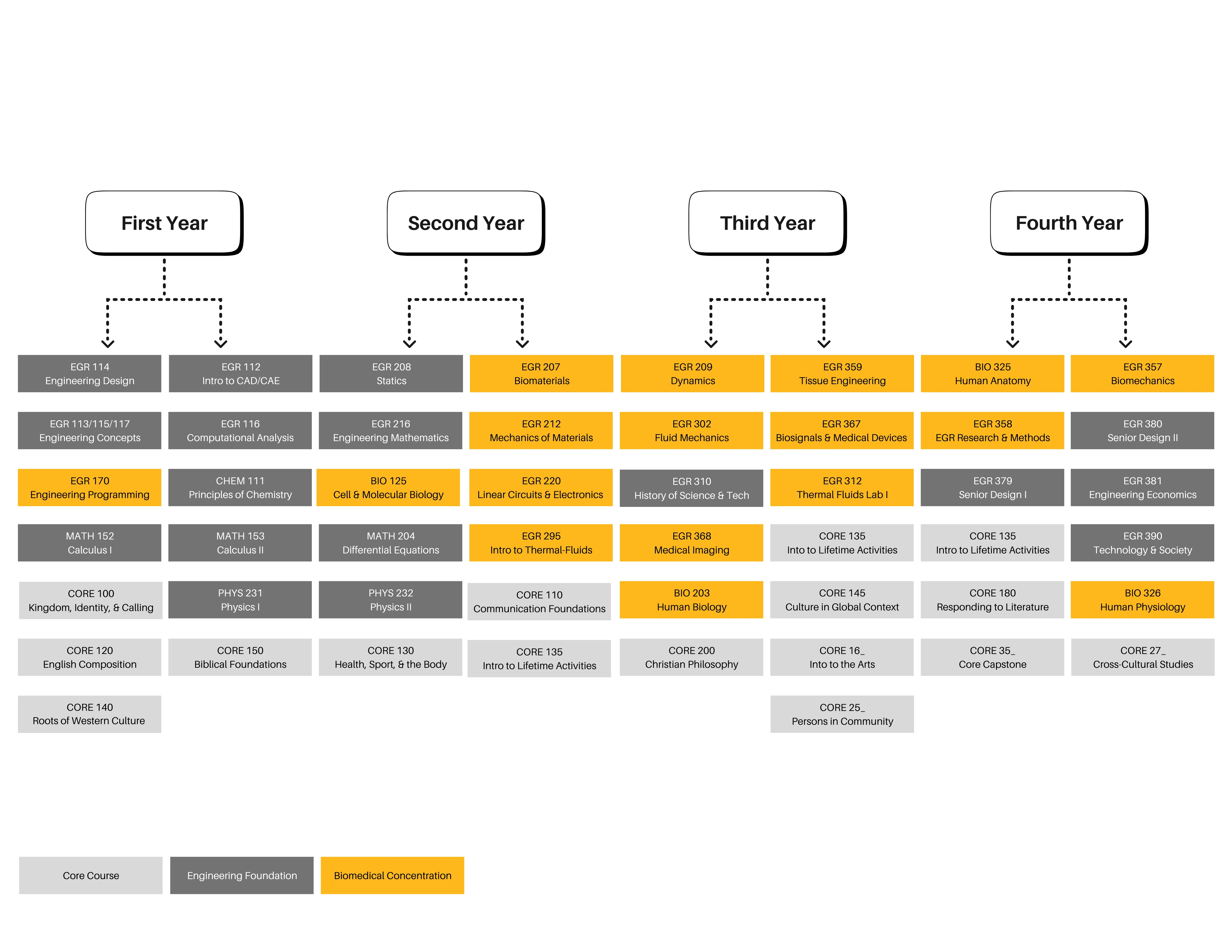
Students who choose the Biomedical Engineering concentration at Dordt University complete coursework in both engineering and biology, exploring how these disciplines intersect to support human health. The curriculum spans a wide spectrum, from cellular biology to material mechanics, and from human anatomy to biomechanics, all revealing how intricately these fields are connected. Required courses include Cellular Biology, Human Anatomy, Biomaterials, Biomechanics, and Tissue Engineering. This interdisciplinary foundation equips students to design technologies that enhance the function of the human body, all within a Christ-centered framework that emphasizes service, stewardship, and innovation.
Ready to take the next step?
Faculty
With experience in a variety of fields, our faculty members are equipped and ready to help you succeed.


Science and Technology Center
While studying biomedical engineering, you'll have the opportunity to spend time in Dordt's Science and Technology Center. Informally known as the "Science Building," the Science and Technology Center is home to labs for mechanical engineering, electronics, electrical engineering, and computer-aided design.
View the Center


Student Stories
Dordt students and alumni use their gifts to make a difference in the world. Check out their stories to see how Defender Nation lives out our mission to work effectively toward Christ-centered renewal in all aspects of contemporary life.


Yielding Fruit
Andrew De HaanDordt's engineering program prepared Andrew De Haan in ways he didn't anticipate — yielding fruit through practical wisdom and joyful faith.
Andrew De Haan
Read More About Andrew De Haan
Grounding in God's Story
Darrin BeekmanDarrin Beekman says Dordt's most valuable gift was grounding in God's story — a foundation of joyful faith that shapes his entire engineering career.
Darrin Beekman
Read More About Darrin BeekmanConnect with us
Submit your information to request more information about Dordt and this program. We'll also use this information to connect you with your admissions counselor!
Loading...
Related Programs & Emphases
Still looking for the right fit? Here are some additional program options that we think might interest you or are often paired with this program. You can also view the programs page to keep exploring your options.


